

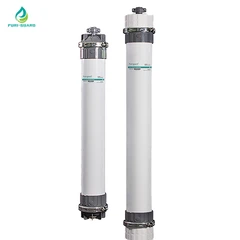
Hey there! As a supplier of Flat Sheet Membranes, I've seen firsthand how the pore size of these membranes can have a huge impact on filtration. In this blog post, I'm gonna break down how pore size affects filtration and why it matters for your specific needs.
First off, let's talk about what flat sheet membranes are. Flat Sheet Membranes are thin, flat membranes that are used in a variety of filtration applications. They're made from different materials like polymers, ceramics, and metals, and they come in different pore sizes. You can check out more about Flat Sheet Membrane on our website.
How Pore Size Works in Filtration
The pore size of a flat sheet membrane is basically the size of the holes in the membrane. These pores act like tiny gates that allow certain things to pass through while blocking others. Think of it like a sieve. If you're using a sieve to separate sand from pebbles, a sieve with larger holes will let the sand through but keep the pebbles out. Similarly, a flat sheet membrane with larger pores will allow larger particles to pass through, while a membrane with smaller pores will block them.
Impact on Particle Retention
One of the most obvious ways pore size affects filtration is in particle retention. If you're trying to filter out large particles like dirt or debris, you'd want a membrane with larger pores. For example, in a water treatment plant where they're removing large sediment from the water, a membrane with a pore size of around 1 - 10 micrometers might be used. These larger pores allow the water to flow through quickly while trapping the big particles.
On the other hand, if you're dealing with very small particles like bacteria or viruses, you'll need a membrane with much smaller pores. A Nanofiltration Membrane Flat Sheet typically has pore sizes in the range of 0.001 - 0.01 micrometers. These tiny pores can effectively block bacteria and viruses, making the water safe to drink.
Effect on Filtration Rate
Pore size also has a big impact on the filtration rate. Generally, membranes with larger pores have a higher filtration rate. This is because there's more space for the fluid (like water or a liquid solution) to pass through. For instance, if you're filtering a large volume of water quickly, a membrane with larger pores will allow the water to flow through faster than a membrane with smaller pores.
However, it's not always as simple as just using a membrane with the largest pores possible. If the pores are too large, you might not be able to achieve the level of filtration you need. So, it's a balance between getting a high filtration rate and ensuring that you're removing the right particles.
Selectivity in Filtration
Another important aspect is selectivity. Different substances have different sizes, and the pore size of the membrane can be chosen to be selective about what passes through. For example, in a pharmaceutical application, you might want to separate a specific protein from a mixture. By choosing a membrane with the right pore size, you can allow the protein to pass through while blocking other larger or smaller molecules.
Applications and Pore Size Selection
Now, let's look at some common applications and how pore size selection plays a crucial role.
Water Treatment
In water treatment, the choice of pore size depends on the source of the water and the level of treatment required. For surface water that might contain a lot of sediment, a microfiltration membrane with pore sizes in the range of 0.1 - 10 micrometers can be used for the initial filtration. This helps to remove large particles like sand, silt, and some bacteria.
For more advanced treatment, like removing dissolved salts or small organic molecules, a Flat Sheet Membrane Filtration system with nanofiltration or reverse osmosis membranes might be used. These membranes have much smaller pore sizes and can achieve a higher level of purification.
Food and Beverage Industry
In the food and beverage industry, flat sheet membranes are used for various purposes such as clarification, concentration, and sterilization. For example, in beer brewing, a membrane with a pore size of around 0.2 - 0.45 micrometers can be used to remove yeast and bacteria from the beer, giving it a clear appearance and a longer shelf - life.
In dairy processing, membranes can be used to separate milk components. A membrane with a specific pore size can be used to separate whey from casein, which is an important step in cheese production.
Biotechnology
In biotechnology, flat sheet membranes are used for cell separation, protein purification, and other processes. For cell separation, a membrane with a pore size that allows the cells to pass through while blocking larger aggregates or debris can be used. In protein purification, the pore size is carefully selected to ensure that only the target protein passes through while other contaminants are retained.
Challenges and Considerations
While pore size is a key factor in filtration, there are also some challenges and considerations.
Fouling
Fouling is a major issue in membrane filtration. Fouling occurs when particles or substances in the fluid being filtered accumulate on the surface or inside the pores of the membrane. Membranes with smaller pores are more prone to fouling because the pores are more easily blocked. This can reduce the filtration rate and the efficiency of the membrane over time.
To deal with fouling, various cleaning and maintenance methods are used. These can include backwashing (forcing the fluid through the membrane in the opposite direction), chemical cleaning, and using pre - filters to remove larger particles before they reach the main membrane.
Compatibility with the Fluid
The fluid being filtered also needs to be compatible with the membrane material and pore size. Some fluids might contain chemicals that can react with the membrane, causing it to degrade or change its properties. For example, strong acids or bases can damage certain polymer membranes. So, it's important to choose a membrane that is chemically resistant to the fluid being filtered.
Conclusion
As you can see, the pore size of flat sheet membranes is a critical factor in filtration. It affects particle retention, filtration rate, selectivity, and has implications for different applications. Whether you're in water treatment, the food and beverage industry, or biotechnology, choosing the right pore size is essential for achieving the best filtration results.
If you're in the market for flat sheet membranes and need help choosing the right pore size for your specific application, don't hesitate to reach out. We're here to assist you in finding the perfect membrane solution for your needs. Let's have a chat about your requirements and see how we can help you optimize your filtration process.


References
- Cheryan, M. Ultrafiltration and Microfiltration Handbook. Technomic Publishing, 1998.
- Mulder, M. Basic Principles of Membrane Technology. Kluwer Academic Publishers, 1996.
- Baker, R. W. Membrane Technology and Applications. John Wiley & Sons, 2004.